
Do I Need to Register for VAT Yet?
A simple guide to understanding when and why to register for VAT in the UK. Covers thresholds, key rules, and your options. Ideal for small business owners nearing £90k turnover
VAT
10/25/20255 min read
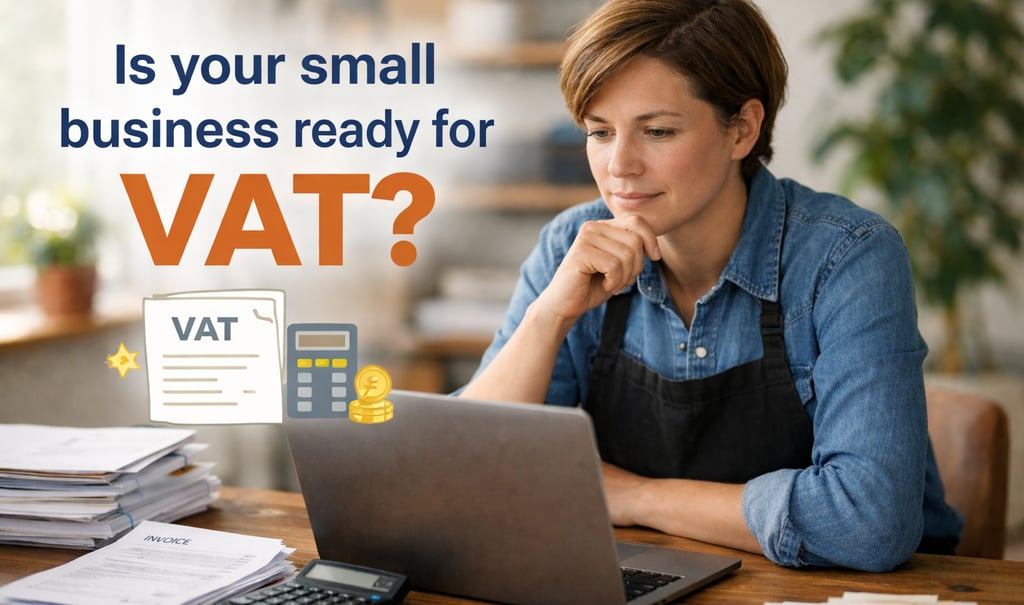
If you’ve been running your business for a while, or things have recently started to pick up, you may find yourself quietly wondering whether VAT is something you now need to think about.
It often starts as a vague concern rather than a clear trigger. Turnover feels healthier. More invoices are going out. Clients are paying more regularly. And somewhere in the background sits the question: “At what point does VAT become my problem?”
It’s a sensible thing to ask. VAT registration isn’t just a technical step. It affects how you price your work, how much admin you take on, and how closely HMRC needs to be involved in your business. For some companies, registering for VAT is a natural and helpful next stage. For others, it’s something to approach carefully and at the right moment.
The key is understanding when VAT becomes mandatory, when it’s optional, and how to think about the decision without pressure or panic.
What VAT Actually Is (and Why It Matters)
VAT stands for Value Added Tax. It’s a tax charged on most goods and services sold in the UK, and it’s ultimately paid by the end customer.
Once your business is VAT-registered, a few practical things change in how you operate day to day:
You add VAT, usually 20%, to your invoices
You submit VAT returns, typically every quarter
You pay VAT to HMRC, or reclaim some VAT on eligible business expenses
If you’re not VAT-registered, none of this applies. You simply invoice your clients for your fees and move on.
What matters is that VAT isn’t based on profit or how much money you personally take out of the business. It’s based on turnover, meaning your total sales. That distinction alone catches out a lot of directors, especially in growing service businesses where profit can lag behind revenue.
The VAT Threshold: £90,000 Explained Properly
As of 1 April 2024, the VAT registration threshold is £90,000 in rolling turnover.
This sounds straightforward, but in practice it’s where most confusion arises.
Here’s what HMRC actually means:
You look at total sales, not profit
You review any rolling 12-month period, not a calendar year
Every month, you look back at the previous 12 months and total the sales
It doesn’t reset in January. It doesn’t wait for your year end. It rolls forward month by month.
A simple example
Imagine your business has been growing steadily rather than explosively. From June 2024 to May 2025, your total sales add up to £92,000. You didn’t notice anything dramatic month by month, but over that rolling 12-month window, you crossed the threshold.
In that situation, VAT registration becomes mandatory at the point you exceed £90,000, and you usually have 30 days to register.
This rolling rule is one of the biggest reasons businesses miss VAT registration. Not because they’re careless, but because it’s not intuitive.
What Happens If You Don’t Register on Time?
If your turnover goes over the threshold and you don’t register when required, HMRC will still expect the VAT to be paid.
That can lead to a few uncomfortable consequences:
VAT being charged backdated on past sales
Interest and possible penalties
Time and stress correcting things after the fact
This doesn’t mean HMRC assumes bad intent. Most missed registrations are genuine oversights. But HMRC’s position is still that VAT should have been charged, whether or not you realised at the time.
That’s why keeping an eye on turnover as the business grows is so important. Early awareness gives you options. Late discovery usually just creates admin.
Can You Register for VAT Before You Have To?
Yes. VAT registration doesn’t have to wait until you hit £90,000.
Many businesses choose to register voluntarily, and in the right circumstances it can be a sensible move. The important thing is that voluntary registration should be a conscious decision, not something done because it feels like the “grown-up” thing to do.
Voluntary registration is often worth considering if:
Most of your clients are VAT-registered businesses who can reclaim the VAT
You have meaningful VAT-able costs and want to recover VAT on expenses
You’re planning for growth and want to avoid a sudden pricing shift later
On the other hand, VAT can be actively unhelpful if:
Your clients are individuals or charities who can’t reclaim VAT
Your margins are tight and VAT would push prices uncomfortably higher
Your costs are low, so there’s little VAT to reclaim
This is where context matters. VAT isn’t inherently good or bad. It’s simply a system that interacts differently with different business models.
What VAT Registration Actually Involves
From a purely practical point of view, registering for VAT is relatively straightforward.
In broad terms, the process looks like this:
You apply online through HMRC
You receive a VAT number, usually within 10 working days
You begin charging VAT from your registration date
You submit VAT returns on an ongoing basis
The bigger issue isn’t the application itself. It’s making sure VAT is set up properly in your bookkeeping system from day one, and that you understand what you’re charging, reclaiming, and reporting.
That setup stage is where most long-term VAT problems either start or are avoided.
Standard VAT vs Flat Rate VAT
Once registered, most small businesses fall into one of two main VAT schemes.
The Standard VAT Scheme
Under the Standard VAT Scheme:
You charge VAT on your sales
You reclaim VAT on eligible purchases
Your VAT return reflects the actual VAT in and out
This gives the most accurate picture of VAT and works well for businesses with regular VAT-able costs.
The Flat Rate Scheme
Under the Flat Rate Scheme:
You still charge VAT at the normal rate
You pay HMRC a fixed lower percentage based on your industry
You usually can’t reclaim VAT on purchases (with limited exceptions)
The Flat Rate Scheme can reduce admin and, in some cases, save money. But it’s not automatically better. For low-cost service businesses, it can sometimes work against you.
The right choice depends on how your business actually runs, not on what sounds simplest.
How We Approach VAT at Smart AI Accounting
We don’t treat VAT as a once-a-year or last-minute compliance issue.
Using tools like Xero, we track turnover properly on a rolling basis, so VAT doesn’t come as a surprise. That gives clients time to think, plan, and adjust before anything becomes urgent.
Our role is to help clients:
Monitor turnover clearly and consistently
Understand when VAT registration becomes relevant
Decide whether voluntary registration makes sense
Choose a VAT scheme that fits their business
Register correctly and stay compliant going forward
A common situation we see is a business quietly approaching the threshold without realising it. Flagging that early often removes stress completely.
A Simple VAT Sense-Check
If you want a straightforward way to think about VAT in your own business, this is a useful starting point:
Over £90,000 in any rolling 12-month period? VAT registration is mandatory
Close to the threshold? Worth reviewing before it becomes urgent
Well below the threshold and selling to consumers? VAT may not be helpful yet
Uncertainty here doesn’t mean you’re behind. It usually just means the business is evolving.
A Final Thought
VAT isn’t something to fear, but it’s also not something to drift into accidentally.
Handled early and set up properly, VAT becomes just another manageable part of running a business. Left too late, it has a habit of creating unnecessary pressure and admin.
If you’re unsure where you stand, the most sensible first step is simply checking the numbers and talking it through before any action is needed. Clarity alone often removes most of the anxiety.
Branding & Message
Social Media
Smart AI Accounting Ltd.
Helping UK small businesses simplify their finances.
© 2025 Smart AI Accounting Ltd. All rights reserved.


Contact Info
📧 info@smartaiaccounting.com
📱 01980 771861, 01980 771868
📍 Amesbury, Salisbury, United Kingdom
🔗 LinkedIn | Facebook
Smart AI Accounting Ltd
Based in Salisbury | Supporting businesses across Amesbury, Wiltshire & the UK